
Digital marketing has a new problem, and most people haven’t fully grasped it yet.
Traffic is getting harder to earn. Engagement is getting weaker. Trust is quietly eroding.
And yet, content production is at an all-time high.
Every day, thousands of blog posts, videos, and landing pages go live. They look polished. They sound intelligent. They follow every best practice in the book.
They rank.
But they don’t resonate.
They don’t teach anything new. They don’t reflect real experience. And they don’t give your audience a reason to stay, trust you, or come back.
This is where the real damage happens.
Because when your content becomes interchangeable with everything else online, your brand becomes forgettable. Your SEO becomes fragile. And your conversions start depending on luck instead of trust.
That’s the cost of AI workslop.
And the worst part is that most companies don’t even realize they’re producing it.
They followed the SEO guide.
They used AI to speed up writing.
They published consistently.
They optimized headings, keywords, and meta descriptions.
They even ‘humanized’ every AI piece they released.
On paper, everything is correct. They’ve done due diligence.
But the content has no original data, no real experience, no strong opinions, and no new ideas. In other words, no soul!
And honestly, people are tired of being workslopped.
What Is AI Workslop, Really?
AI slop is the mass production of low-effort, low-value content created to game algorithms rather than inform, entertain or inspire real audiences.
Think generic listicles, repetitive “thought leadership”, and SEO-stuffed pages that say a lot without actually saying anything at all.
This content is cheap to produce, endlessly replicable and increasingly hard to distinguish from credible editorial at a glance, unless you are actually the intended reader and you have the time to read because you’re in a bind for a solution.
Now, AI workslop is the polished, hollow output that generative AI produces when quantity matters more than quality.
The Harvard Business Review defines workslop as “AI-generated work content that masquerades as good work, but lacks the substance to meaningfully advance a given task .”
On a personal level, the definition is even simpler: workslop is the content that makes your audience click away, lose trust, and never come back.
This is a crisis for marketing teams across organizations globally.
In 2025, online mentions of “slop” grew by more than 200%, jumping 40% in October alone, as social media users called out lazy marketing, low-effort videos, and overly generic content.
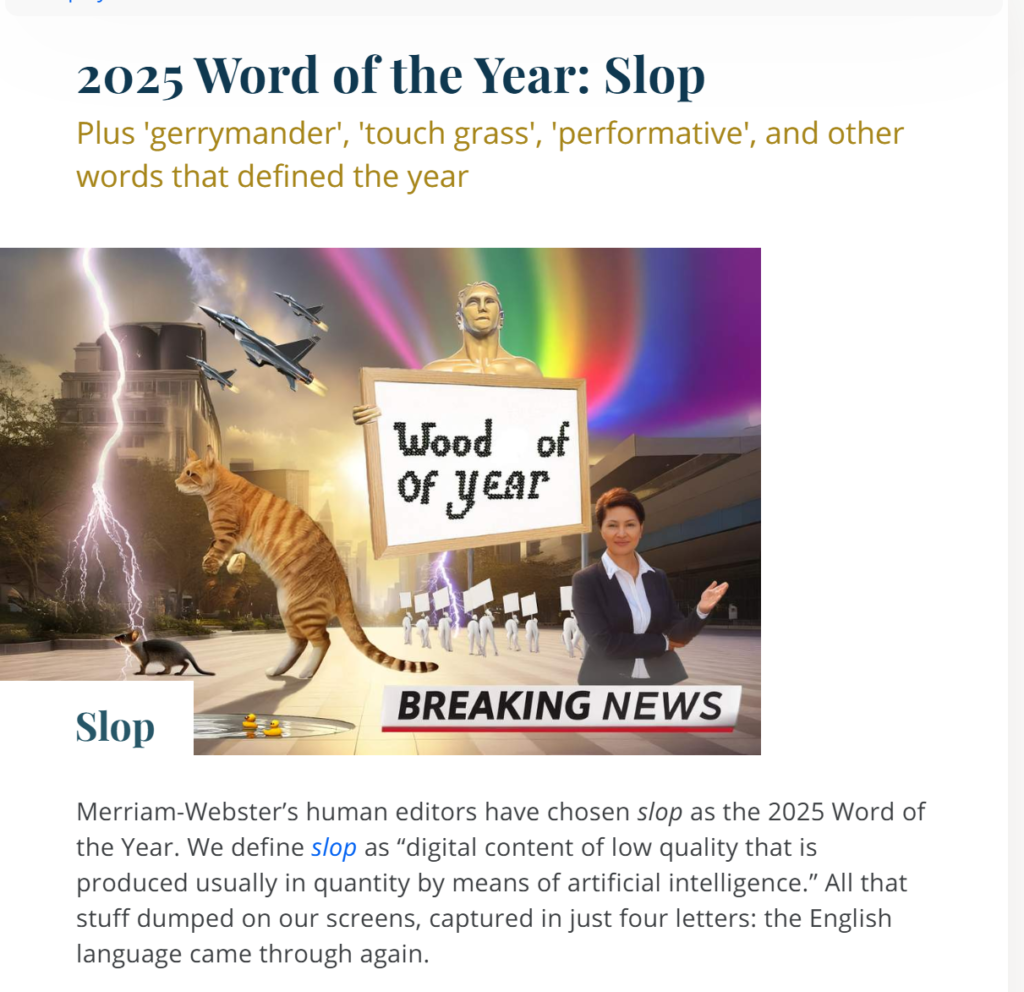
Merriam-Webster made “slop” its word of the year, defining it as “digital content of low quality that is produced usually in quantity by means of artificial intelligence.”
But here’s what separates slop from workslop:
| AI Slop (General) | AI Workslop (Workplace & Marketing) |
|---|---|
| Flooding social feeds and search results | Poisoning email campaigns, blog posts, and ad copy |
| Created to game algorithms for views and clicks | Created to hit volume targets without real strategy |
| Makes the internet worse for everyone | Makes your brand less trustworthy, measurable, and effective |
| Erodes trust in online content broadly | Erodes trust in your brand specifically |
Trendslop
Ben Crawford, co-founder of Brainwaves, calls a specific flavor of this problem trendslop.
He explains: “Marketers are getting coherent, well-structured, completely generic thinking from AI. The problem isn’t the technology. Strategy is about uncovering what’s distinctively true about a brand and turning it into an advantage no one else can exploit. You don’t get there by averaging the internet.”
But is it about time we start thinking in another direction, a direction that seeks to question whether AI is actually the problem?
Because, come to think of it, brands, creatives and story tellers used to spend weeks crafting masterpieces. Prior to the AI era, we had quality content. I could spend hours reading articles from the likes of Backlinko, SEMrush, Blogtyrant, etc.
Today, I rarely do that, because coming across genuinely helpful content in 2026, published in 2026, is almost impossible.
But, I will address that in another piece.
“If you skip the edit, you’re outsourcing your judgment. And that judgment is what makes the work human.”
– Ariel Meadow Stallings, writer and small business consultant
The Hard Numbers: How Workslop is Destroying Marketing ROI
The real cost of AI workshop isn’t bad writing, it’s real financial damage.
Let’s look at the data.
The productivity paradox
Research from Stanford Social Media Lab and BetterUp Labs found that 40% of workers had received workslop in the prior month, and each instance can cost up to two hours in cleanup, review, or revision.
When you scale that across a marketing team, the hidden costs become staggering.
The MIT report referenced by Forbes suggests that only 5% of genAI efforts are delivering measurable value.
AI errors are routine, not rare
NP Digital’s 2026 AI Hallucinations and Accuracy Report surveyed 565 digital marketers.
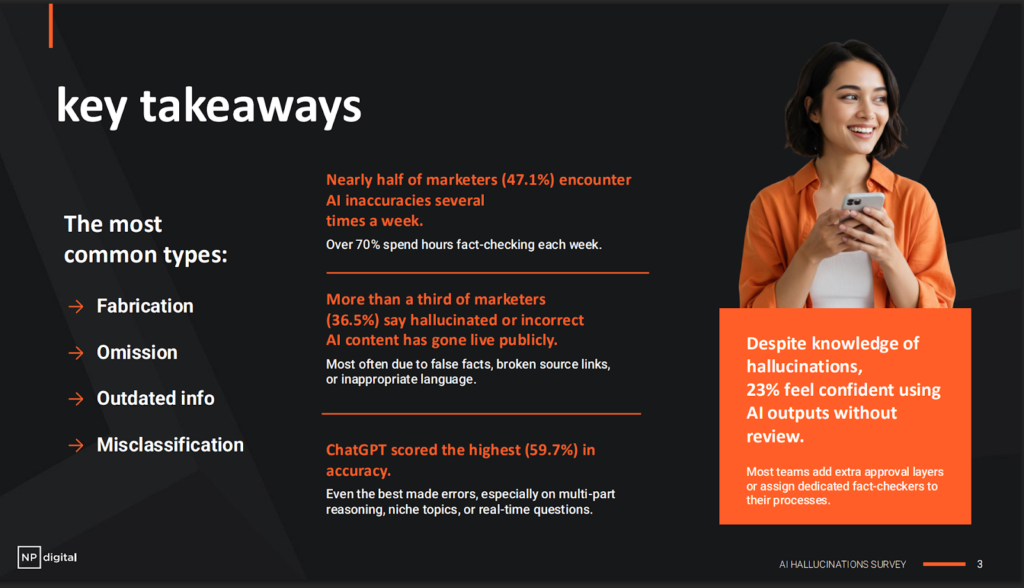
The findings are sobering:
- 47.1% of marketers encounter AI errors several times per week
- 36.5% have published hallucinated or incorrect AI content publicly
- More than 70% spend 1–5 hours each week fact-checking AI output
- 57.7% reported that clients questioned the quality of AI-assisted outputs
In other words, the tool you thought would save time is creating more work while damaging client trust.
Consumers are catching on
I lead the marketing division at Cloudoon, a company that owns Truehost, Cloudpap and Olitt, and time and time again I’ve told my team, our customers aren’t stupid.
And for anyone to think otherwise is shooting themselves in the leg.
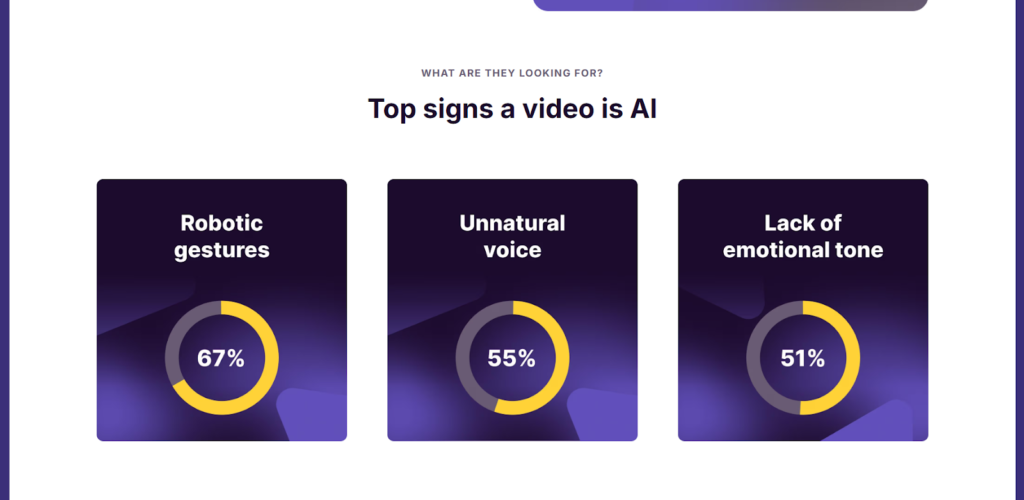
In fact, nearly 83% of consumers say they’ve watched a video they suspected was AI-generated citing things like:
- Robotic gestures (67%),
- Unnatural voices (55%), and
- Lack of emotional tone (51%) as the biggest giveaways
This is according to Animoto’s State of Video 2026 Report. Now, what’s even more important stat from the report is that 36% of the consumers say an AI generated video would lower their perception of the brand drastically.
So, it’s not just blog posts, it’s video, it’s social posts, it’s email campaigns, it’s podcasts.
You are actively alienating potential customers every time you publish workslop.
SEO Suicide: Why Workslop Kills Your Rankings
Google has made its position clear. The February 2026 Discover core update is “cracking down on low-quality AI-generated content and rewarding sites that demonstrate true topical authority.”
Generative search’s increasing focus on authoritative, high-quality content is now turning the tide on low-quality content mass-generated by gen AI with minimal or no human overview[reference:22].
In 2026, the winning SEO strategy isn’t about more volume; it’s about a ruthless cull. Quality-over-quantity enforcement has moved beyond simple detection to a more sophisticated functional evaluation, sharpening the focus on experience and expertise.
Five red flags your AI content is hurting your rankings
Based on IT Brief’s analysis of Google’s 2026 updates, here’s what to watch for:
- Zero information gain. Google’s algorithms now prioritise “information gain”—the measure of new, unique, authoritative information a page adds to the existing web index. If your AI content simply paraphrases what’s already out there, it will be classed as “AI slop”
- High click-through but low engagement. If users bounce back to Google within 30 seconds, that signals your content isn’t helpful[reference:25].
- Generic expertise missing E‑E‑A‑T. AI can explain how something works, but not the experience of doing it. Content lacking first-person pronouns, original photography, or specific anecdotes is a massive red flag[reference:26].
- No verified author byline. Google’s systems now flag generic, anonymous expertise as untrustworthy. Every article needs an author bio proving real experience[reference:27].
- You wouldn’t let an intern publish it unedited. As one marketer put it: “If you wouldn’t let an intern publish unedited work under your brand, don’t let GenAI do it either”[reference:28].
The Content Marketing Funnel Is Breaking
Workslop doesn’t just hurt rankings. It breaks the entire customer journey.
Top of funnel (awareness)
You publish a blog post promising “10 proven strategies for X.” But the AI writes generic advice any beginner could guess. The reader learns nothing new. They don’t trust you. They close the tab.
Result: zero leads captured. Zero brand recall. Zero reason to return.
Middle of funnel (consideration)
Your email sequence compares your product to competitors. But the AI uses vague phrases like “we’re the best choice for modern teams.” No specifics. No proof. No stories that stick.
Result: the prospect goes to a competitor who actually explains why they’re different.
Bottom of funnel (decision)
A case study page written entirely by AI. It says “Client X saw amazing results after using our service.” But there are no numbers, no timeline, no quote from the client, no photo of the team.
Result: the deal stalls. Trust never forms. The sale goes elsewhere.
Nick Mattar, author of Generative AI for Marketers, sums it up: “An AI content strategy without a human vision is like watching the same movie over and over again”[reference:29].
The Trust Erosion Nobody Is Talking About
This is the hidden cost that keeps me up at night.
When coworkers receive workslop, they are often required to take on the burden of decoding the content, inferring missed or false context”[reference:30]. The Harvard Business Review study found that about half of those surveyed viewed colleagues who sent workslop as “less creative, capable, and reliable than they did before receiving the output”—while 42% saw them as less trustworthy[reference:31].
The same logic applies to brands.
Every time a customer encounters workslop from your company, you become less trustworthy in their eyes. Less reliable. Less intelligent. Less worth their time.
“What makes AI hallucinations especially dangerous is that many of them look believable at first glance. Without proper vetting and human review, those errors can reach clients or the public and erode trust and damage brand reputation.”
– Chad Gilbert, VP of Content at NP Digital[reference:32]
In a world where 90% of online content could be AI-generated by the end of 2026, according to Europol estimates cited by Resemble AI, trust becomes the scarcest and most valuable resource[reference:33].
How to Fight Back: The “Unslop” Playbook
I’m not anti-AI. I use it every day. But I’ve learned the hard way what separates slop from substance.
Here’s my personal playbook for keeping workslop out of your marketing.
1) Build an “unslop” command
Tim Metz at Animalz created a custom “unslop” command that cuts slop from AI-generated documents and frees writers to focus on high-value editorial work, strategy, and research instead of repetitive tasks[reference:34].
You can do the same. Create a prompt that explicitly tells the AI: Avoid generic phrasing. Use specific examples. Never invent data. Flag any claim you’re uncertain about.
2) Use AI for structure, not soul
Prompt the AI to give you an outline. Ask for five possible headlines. Request a list of questions a beginner would ask.
Then you write the answers. Use your own experience. Your own stories. Your own voice.
3) Add “human‑only” sections
After generating a draft, highlight every sentence that comes from your personal knowledge. If a paragraph has no highlights, rewrite it or delete it entirely.
I call this the orange highlighter test. It works every time.
4) Break the AI’s rhythm
AI loves symmetry. It writes paragraphs of equal length. It repeats sentence structures. It overuses transition words like “moreover” and “additionally.”
Go through your draft and:
- Cut a long paragraph down to one punchy sentence
- Add a two‑word paragraph (“So what?”)
- Throw in a numbered list that starts mid‑sentence
- Use real examples from your work
Your readers’ eyes will thank you.
5) Fact‑check every single claim
This is non‑negotiable. Take five minutes to verify every fact. Replace “studies show” with a real citation. Delete anything you can’t confirm.
Remember: 36.5% of marketers have published incorrect AI content. Don’t be one of them[reference:35].
6) Read your post out loud
This is my secret weapon. If I stumble while reading aloud, the sentence is workslop. Rewrite until it sounds like you talking to a friend.
7) Embrace hybrid workflows
Companies using hybrid workflows—where AI drafts content and humans refine it—report 14% higher featured snippet rankings than those using purely manual or AI-only methods[reference:36].
Human-written content still outperforms in semantic richness, achieving 18% lower bounce rates and 41% longer session durations[reference:37].
The magic isn’t in the AI. It’s in the partnership.
A Final Word for Digital Marketers
You have a choice.
You can chase volume. Pump out workslop at scale. Watch your metrics look busy but hollow. Burn your audience’s trust one generic paragraph at a time.
Or you can write less. Edit harder. Use AI as a junior assistant—not the lead writer.
Your rankings will recover. Your emails will get opened. Your readers will stay until the end.
And when the next core update hits, you won’t be the one watching your organic traffic evaporate overnight.
The brands that win in 2026 and beyond won’t be the ones producing the most content. They’ll be the ones producing the most trustworthy content.
They’ll be the ones who remembered that behind every click, every view, every conversion is a human being who can spot workslop from a mile away.
Now go write something only you could write.
Want to audit your existing content for workslop? Start with your top 10 blog posts. Check for generic phrasing, missing author bylines, and zero information gain. Delete or rewrite anything that fails the test. Your SEO rankings will thank you.
